RESEARCH
I study how how subtle changes in plant morphology affect plant-arthropod interactions. Often, this means putting myself in a bug's shoes and imaging what it would be like to navigate a leaf. Structures that are invisible to the human eye suddenly loom large: Dense hairs may provide a cozy refuge from predators or create an unnavigable thicket. Biting into the leaf, insect herbivores face needlelike crystals, barbed hairs, and glands filled with poisons. Nectaries (fountains of sugar!) may attract ants and other predatory arthropods, adding to the rewards - or danger - of life on a leaf. This tiny landscape, the phylloplane, serves as a crucial interface between a plant and its environment, but there is a lot we don't know about its structure and function. My research spans three broad topics, united by a drive to understand how tiny phenotypic changes can have big effects on species interactions.
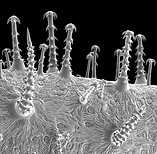
Comparative Micromorphology
Many physiologically and ecologically important plant traits are invisible to the naked eye. Research that visualizes, quantifies, and manipulates these traits is essential to improve our understanding of plant form and function and, in turn, their ecological and ecosystem-level impacts.
Much of my research has focused on the evolution and diversity of trichomes (plant hairs): ubiquitous, ecologically important plant structures that display extensive phenotypic diversity. Trichomes play essential roles in plant defense, form the structures that mediate mutualisms, and protect plants from abiotic stressors.
Associated publications:
Glos, R.A.E., Weber, M. G. 2025. Multiple metrics of trichome diversity reveal independent evolutionary patterns in blazingstars (Mentzelia; Loasaceae). Evolution. 79:1056-1072.
Onyenedum, J.G., Sousa-Baena, M. S., Hunt, L. M., Acevedo, A. A., Glos, R.A.E., Anderson, C.T. 2025. Gelatinous fibers develop asymmetrically to support bends and coils in common bean vines (Phaseolus vulgaris). American Journal of Botany. e70014.
Chery, J.G., Glos, R.A.E., Anderson, C.T. 2022. Do woody vines use gelatinous fibers to climb? New Phytologist 233: 126-131..
Glos, R.A.E., Salzman, S., Calonje, M. et al. 2022. Leaflet Anatomical Diversity in Zamia (Cycadales: Zamiaceae) Shows Little Correlation with Phylogeny and Climate. Botanical Review.

Consequences of Variation in Mutualistic Traits
We can learn a lot about the evolution and ecology of mutualisms by studying variation in the traits that mediate them. Recently, I have focused on two common, but understudied, traits that mediate defense mutualisms in plants: post-floral nectar and mite domatia.
Post-floral nectar arises when floral nectaries continue functioning during fruit development. Because it attracts ants to inflorescences, this "fruit nectar" is useful for studying how simultaneous interactions between ants, herbivores, and pollinators affect plant fitness.
Mite domatia are small structures on leaves that facilitate interactions between plants and mutualist mites. A growing body of literature has demonstrated that domatia are important for plant defense, yet we lack basic information about the chemical and morphological traits that make domatia attractive to mites. This is what I am currently studying as a Postdoctoral Fellow.
Associated publications:
Glos, R. A. E.*, Soule, A. J.*, Adams, A.R. , Arnett, M., Eckman, J.M., Hane, Q. I. , Logan, A. M., Morterud, E. R. , Noeker, D.J. , Talbot, C.A., Ugorji, W., VanOstran, E., Yuhas, A., Zosel, R., and Weber., M.G. 2026. Micromorphology and chemistry of mite domatia: mutualistic trait convergence and variation across eight sympatric North American species. 100: 77-87. Symbiosis. *Co first authors
-> Check out this neat article about the paper and the undergraduate class that made it possible.

Trait-Trait Interactions in Plant Defense
Plants wield an array of physical and chemical traits against herbivores. It has long been hypothesized that these traits could have non-additive effects, but evidence for synergy as a defense strategy remains limited. It is important to study the combined impacts of defense traits, or else we risk under- or over-estimated their effects on herbivores.
In a recent study, I experimentally tested the separate and combined effects of two common plant defenses – non-glandular trichomes and leaf chemistry – on the performance of a chewing herbivore as it fed on desert stingbush (Eucnide urens). The two defenses caused a striking synergistic reduction in caterpillar growth, offering rare empirical evidence for positive interactions between two common categories of plant defense and clarifying why plants invest in such an array of defense traits.
Associated publications:
Glos, R.A.E., Soule, A. J., Weber, M. G. 2026. Separate and synergistic anti-herbivore effects of non-glandular trichomes and leaf chemistry in a desert plant. Functional Ecology. 2026;00:1–14.
-> “Behind the Paper” blog post written for lay audiences: https://functionalecologists.com/2026/03/04/rosemary-glos-trapped-poked-and-poisoned-evidence-for-defence-synergisms-in-a-desert-plant/